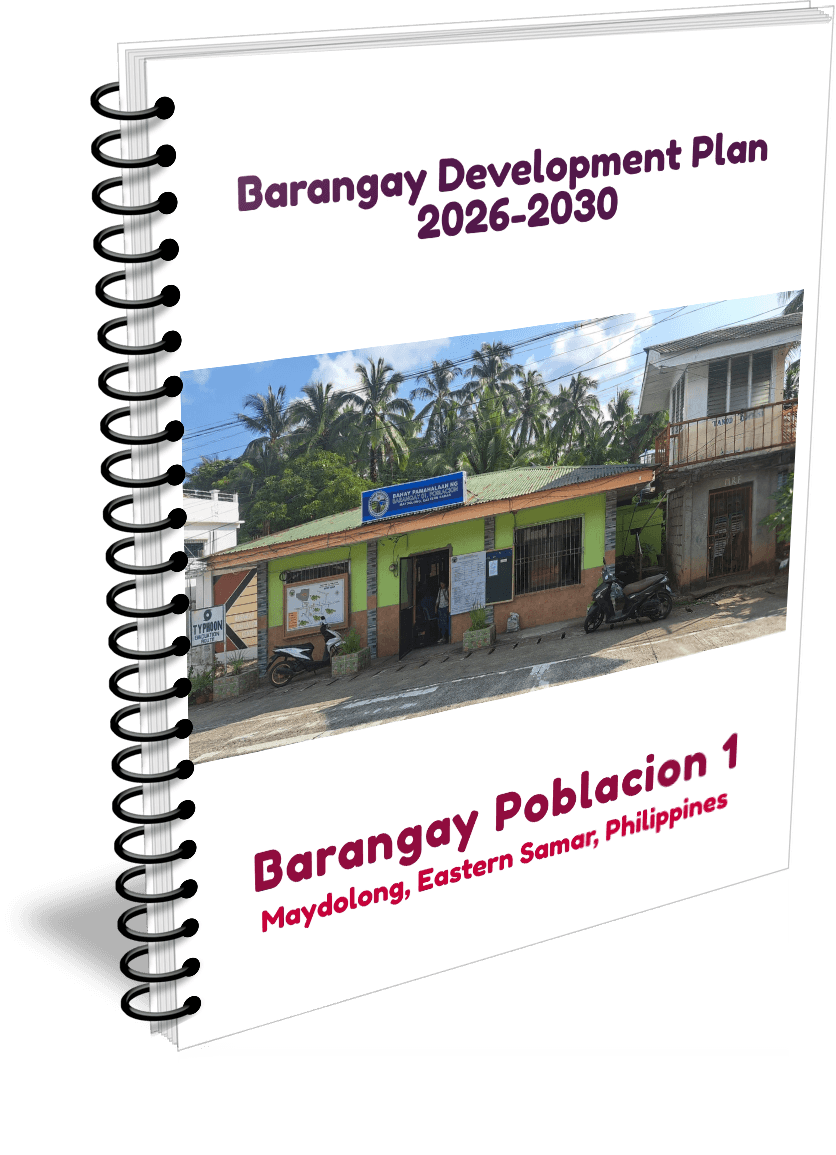
Barangay Development Plan 2026 - 2030
BARANGAY POBLACION 1, MAYDOLONG, EASTERN SAMAR, PHILIPPINES
MESSAGE
To our beloved constituents in Barangay Poblacion 1: I am happy to share with you this Barangay Development Plan. We finally see in print what we have been thinking together, discussing together, and dreaming together. With clarity of purpose, we can now in unity brave the future with this roadmap.
This plan reflects our collective vision for a transformed barangay: from an average community to one that outperforms the best. It outlines strategic goals and projects designed to improve the quality of our lives in terms of health, economic means, and social cohesion. It claims bias for sustainability as it is also forward-looking, mindful of the needs of the generations that will follow us.
We are aware of the challenges we face. Access to essential public goods and services remains inadequate. Scant infrastructure hinders our mobility and value-adding capacity. Scarcity in public and private investments that in turn inhibits livelihood opportunities is an overarching limitation, which is both a cause and an effect of poverty.
We thoroughly considered our issues. By recognizing our weaknesses, we believe the work is halfway done. But I cannot say this plan is perfect. It shall evolve as we move confidently forward.
To our neighboring barangays: we look forward to collaborating with you in activities that are of common interest to us.
To the municipal LGU and the higher levels of government: as we navigate our development path, we will be empowered by your guidance. It will be a pleasure to be of consequence in positively contributing to the achievement of bigger goals.
JANE SHARYL M. ARAUS
Punong Barangay
INTRODUCTION
RATIONALE
Paragraph (b), Section 109, Title VI, of the Local Government Code of 1991 (R.A. 7160) tasks the barangay development council to “prepare barangay development plans based on local requirements,” among other mandates.
The people of Barangay Poblacion 1, through its leaders, further wish to stress that, with or without an enabling law, it is in their long-term interest to exploit development opportunities for its constituents that can be vetted, analyzed, and prioritized by formulating a development plan.
BDP OBJECTIVES, SCOPE, AND METHODOLOGY
This Barangay Development Plan (BDP) aims to examine our internal strengths and weaknesses and explore opportunities and threats from the external environment. This examination shall provide a basis for the formulation of our long-term strategies as the vehicle by which the barangay may realize its vision. The strategies shall further inform and justify the prioritization of proposed Programs, Projects, and Activities (PPAs).
The BDP covers 5 years, from 2026 to 2030. It consists of five major sections: (1) Barangay Profile, (2) Situation Analysis, (3) Strategic Actions, (4) List of Programs, Projects, and Activities, and (5) Monitoring and Evaluation Framework.
The planning process adopted a methodology that was participatory and inclusive. Barangay officials, staff, volunteers, among others, participated in brainstorming sessions, group discussions, and interviews that served as bases for the updating of data. The Barangay Health Workers interviewed households to validate the key elements of the demographic profile of the barangay. A barangay assembly meeting was conducted in which the BDP was presented for review and feedbacking.
BRIEF HISTORY OF THE BARANGAY
Barangay Poblacion 1 shares many historical milestones with other barangays that constitute the Municipality of Maydolong. The latter used to be a barrio of Borongan, the capital town (now a city) of the Province of Eastern Samar, until Republic Act 609 came into effect on 1 May 1951.
RA 609 established Maydolong as a chartered municipality. Maydolong started with twelve barrios and/or sitios, namely: Balogo, Maybocog, Omawas, Tagaslian, Kampakirit, Suribao, Mayburak, Kanmanongdong, Malobago, Tabi, Maytigbao, and Canloterio. In 1960, RA 2891 transferred the barrio of Balogo and the sitio of Tabi to the Municipality of Balangkayan. Three years later, in 1963, RA 3590 promulgated the Revised Barrio Charter, giving rise to the establishment of seven población barrios in the municipality.
Presidential Decree 557 (1974) renamed “barrios” to “barangays”. Barangay Poblacion 1 thus came into being, one of the present twenty component barangays of the municipality. Its early settlers were members of clans that inhabited the población from the beginning. Prominent among them were the Bajado, Montes, Aberia, and Corado clans.
Eugenio “Itay Inyong” Bajado served as the first teniente del barrio of the barangay. Being largely uncompensated, only a few community members volunteered to assume leadership roles. It was only when the Local Government Code was enacted in 1991 that barangay officials started to receive a monthly honorarium.
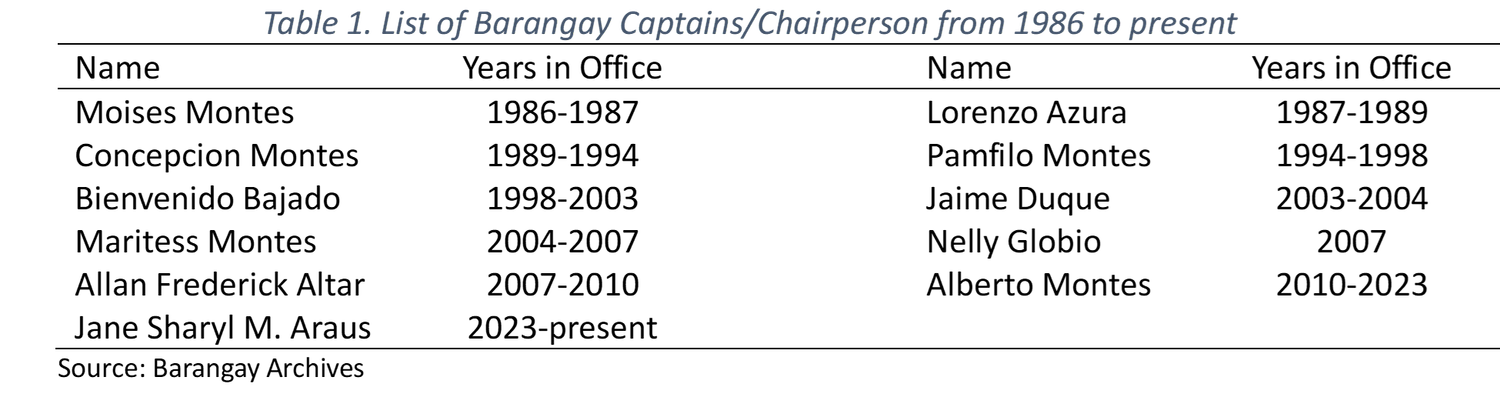
Appointed local government officials replaced the incumbent officials when a revolutionary government came to power in 1986. The first set of elected barangay officials assumed office after the local elections were held following the adoption of the 1987 Philippine Constitution. Shown in the table below is the roster of Barangay Poblacion 1 barangay captains/chairpersons from 1986 onwards.
The barangay has six major puroks, namely: (1) Lubo, (2) Highway, (3) Canhusay, (4) Bagwa, (5) Surok, and (6) Burabod.
BARANGAY PROFILE
NATURAL AND PHYSICAL ENVIRONMENT
The barangay has six major puroks, namely: (1) Lubo, (2) Highway, (3) Canhusay, (4) Bagwa, (5) Surok, and (6) Burabod.
Ingming Aberia blog joins the dreamers and doers who plant the seeds of hope for a better world. It lobbies for social leveling and respect for human rights, promoting each person's God-given dignity and birthrights.
It does not intend to offend anyone, but where there is inequity, it shall seek a position where it can inspire people to shake up the status quo.
Newsletter
Subscribe now to get daily updates.
Created with ©systeme.io